5. Nodes, Pins, Wires, and Execution
The Incident Triage Flow carries data from Trim String through Contains into Branch. A separate execution path starts at the event and reaches one logging node. One path supplies the decision; the other decides what runs next.
This separation underpins Flow-Like’s execution model. FlowScript expressions describe value-producing nodes, while statements and control blocks describe execution wiring. When a Flow surprises us, trace execution forward and data backward.
Release check: The static contracts in this chapter are verified against the current Board, node, pin, FlowScript reconciliation, and Rust executor implementations. Before publication, capture the exact pin shapes, wire styles, Handle Errors gesture, Sequence behavior, and Parallel Execution behavior in the release used for publication. Configured defaults persist; runtime pin values are deliberately transient.
5.1 A node is a typed operation
Section titled “5.1 A node is a typed operation”A node is the smallest named operation shared by Flow-Like’s authoring tools and runtime.
For an author, a node might trim a string, send a request, write a record, call a model, or choose an execution path. In FlowScript, using one often looks like a normal function or method call:
const normalized = report.trim()That spelling still resolves to a catalog node. Open the Flow in Studio and the canvas shows the operation, its pins, and its place in the Flow.
Its catalog identity carries a contract. A node can declare:
- a machine-readable type name and a human-readable name, description, category, icon, and documentation;
- typed input and output pins, including defaults, schemas, and constraints;
- whether it takes part in execution or only produces values;
- schema/migration version and environment restrictions;
- OAuth requirements and, for external WASM nodes, requested capabilities; and
- optional privacy, security, performance, governance, reliability, and cost signals.
Nodes may omit some metadata, and metadata cannot prove an implementation correct. It still gives the platform a surface to inspect before execution and an identity for later run evidence. Custom WASM nodes, for example, request specific capabilities such as networking, storage, model access, or function calls. Later chapters examine how each execution mode enforces them.
A domain expert can point to a business step by name. Developers see the same identity in its contract, and operators see it again in the run log.
Two terms need precise definitions. Standard refers to catalog classification, not whether a node is built in. A pure node has no Execution pins. A node with any Execution pin is impure, regardless of its size or source package.
5.2 Data pins carry values
Section titled “5.2 Data pins carry values”Pins are a node’s public boundary. An input pin states what the operation accepts. An output pin states what it produces. A data wire connects an output to a compatible input and answers one question:
Where will this input get its value?
Direction is part of the contract. Two pins labeled Message are incompatible if both accept or
both produce a value. Studio rejects those connections, along with self-connections.
The graph model also distinguishes strings, integers, floats, booleans, dates, paths, bytes, structured values, generic values, and Execution. Value shape separates scalars from arrays, maps, and sets. Structured pins can carry a schema with known fields.
Our first Flow already used this system:
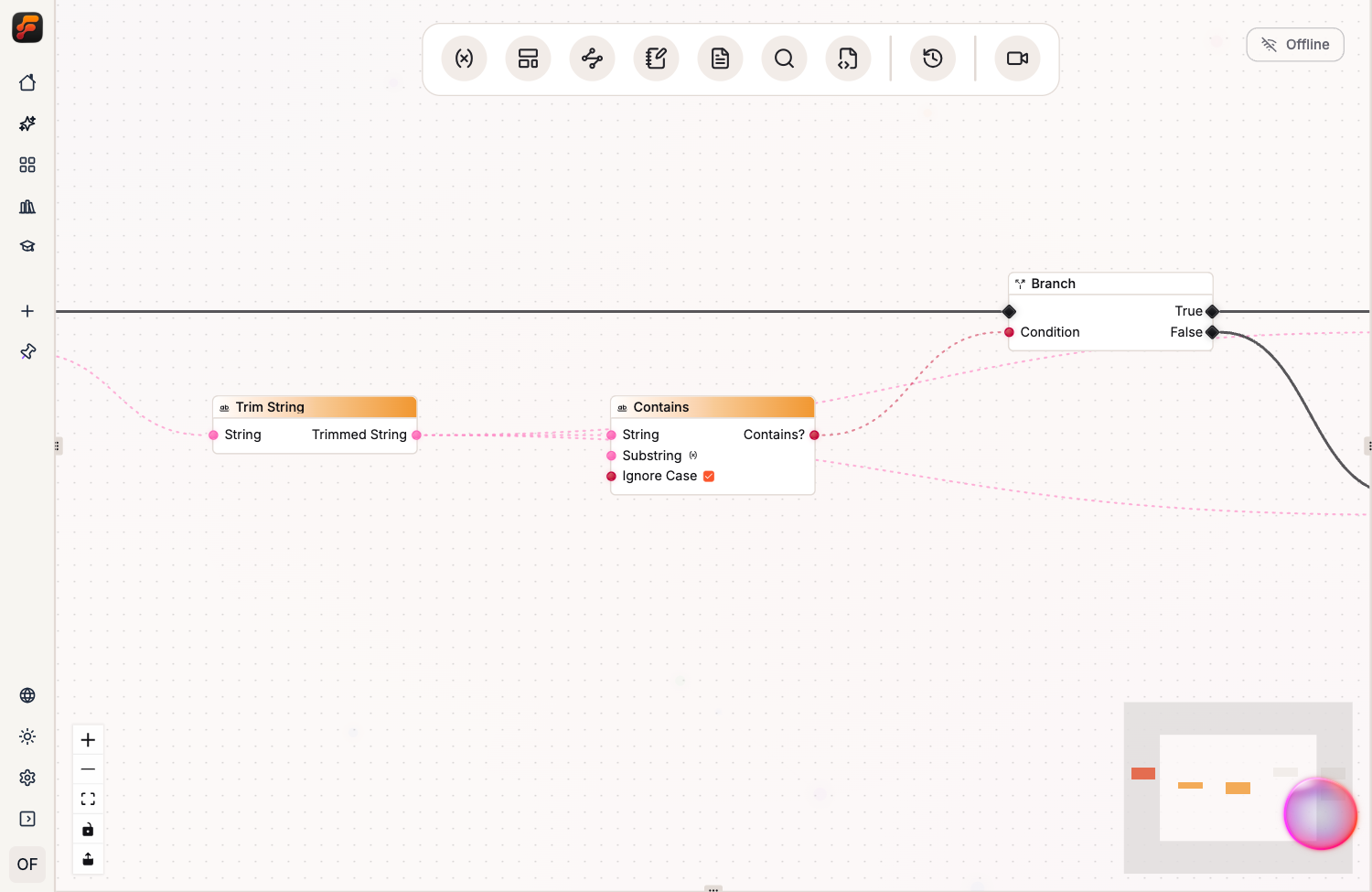
Contains can feed Branch because both pins use one Boolean. Wiring that output to a String input fails during authoring, exposing the type error before a production run.
Generic pins provide controlled flexibility. A generic formatter may accept several concrete types. Once a wire resolves that generic, connected pins must remain compatible with the resolved contract. Type inference still enforces the resulting type.
Pins may also define choices, numeric ranges, sensitive literals, or schema rules. Studio uses this metadata to build the appropriate editor.
An input can receive its value in two ways:
- A data wire supplies it from an upstream output.
- With no upstream source, the node uses a configured default when its contract provides one.
Execution can therefore reach a node with no wire on one input. The node uses its default if the contract provides one; otherwise evaluation may fail there. Data wires do not schedule nodes.
The Board persists definitions, connections, and configured defaults. Values evaluated during a run live in memory and are excluded from pin serialization. A node may log selected evidence, but persisting every value would be costly and could copy sensitive data into logs. Evidence belongs to the node contract and the organization’s policy.
For debugging, the practical rule is to work backward. Begin at a surprising input and follow its data wire to the producer. Repeat until the first surprising value or missing source appears. Looking only at the execution path cannot answer where the value came from.
5.3 Execution pins carry order
Section titled “5.3 Execution pins carry order”Execution pins determine when control may proceed. Application data travels on data pins.
An execution input asks what must activate before the node runs. An execution output selects the path eligible after completion or an outcome. The Studio canvas currently draws these as diamond pins. Color and styling may change; the Execution type defines their behavior.
Return to the Incident Triage Flow:
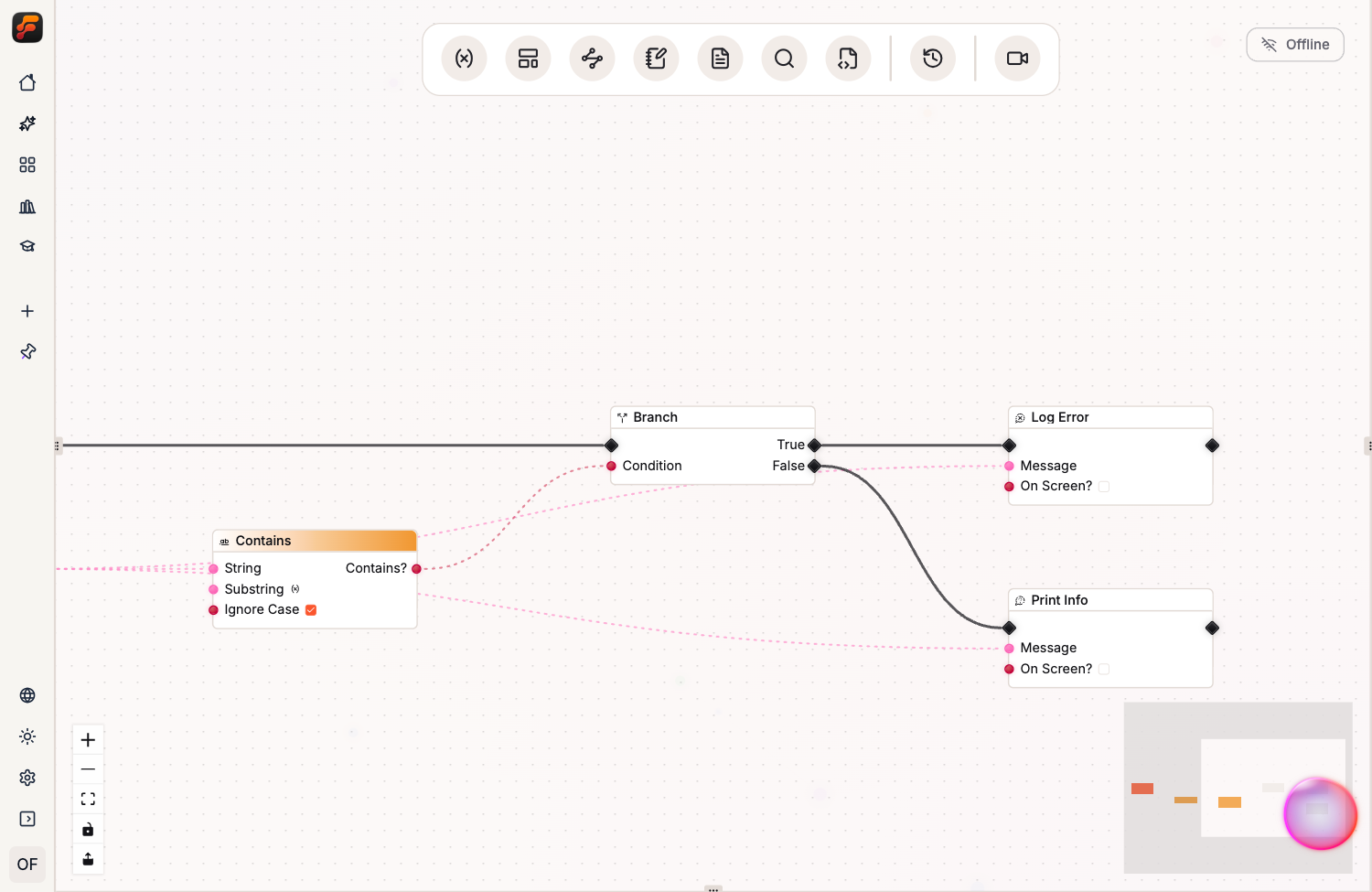
The event starts control. Branch evaluates its Boolean input and activates one execution output. The selected logger runs when control reaches it; a populated Message input alone cannot start it.
FlowScript renders this part of the Flow as familiar control flow:
if (normalized.contains({ substring: "production is on hold", ignoreCase: true })) { error({ message: normalized, toast: false })} else { info({ message: normalized, toast: false })}The if represents the Branch node and its True and False execution outputs. Statements in each
block are the impure nodes wired to that output.
Ordinary consecutive impure statements similarly represent an execution chain. Their order in source is meaningful because their side effects are meaningful. Sending a message before creating its recipient, charging a customer before validating an order, or writing a completion record before the work finishes are different programs even if every data value is available.
A failed impure node normally stops its forward path. Its ordinary successors are not queued, and the run records the failed node. Recoverable failure stays visible on the Board.
Some nodes define outcome paths. The current API Call node exposes Success and Error outputs. A completed HTTP exchange selects one based on status and keeps the response as data. A transport failure produces a node error instead of a completed response outcome.
For an unexpected error on any executable node, including one with a normal Error outcome, the current Studio toolbar can enable Handle Errors. It adds an On Error execution output and an Error string output. A connected handler runs after failure. The original node stays in Error state and retains its attributed evidence, even when handling prevents the error from unwinding the run.
The Flow author can route expected failures into a retry, fallback, ticket, or human review. The organization’s policy determines whether the Flow recovers or stops.
5.4 Pure work is demand-driven
Section titled “5.4 Pure work is demand-driven”A pure node has data pins and no Execution pins. It does not occupy a place on the control path. Instead, a consumer pulls its output when that output is needed.
In our first Flow, Branch needs its Condition. To obtain it, the executor follows the data dependency to Contains. Contains in turn needs the normalized report, so the executor follows the next dependency to Trim String. The canvas records that backward chain of demand:
The result then travels to the consumer without execution wires. An unconsumed pure chain does not run merely because an event started. Producers do not fire their consumers; executing nodes pull the values they need. A pure node may be evaluated zero, one, or several times depending on its consumers and execution contexts. Work that must happen once, costs money, or changes an external system belongs on an explicit execution path.
The runtime detects purity structurally: any Execution pin makes a node impure. Node authors must declare that boundary honestly. Giving a network call only data pins would conceal cost and failure behind demand-driven evaluation. Declared WASM capabilities add enforcement, though pin shape alone cannot prove referential transparency.
A useful design test is:
Would it be harmless if this operation were evaluated zero times or more than once?
Trimming, comparing, selecting a field, and formatting a value usually pass. Sending, charging, mutating, calling a paid model, or asking an unreliable external system usually fail. Put the latter group on the execution path, where order and failure remain visible.
When debugging, use two passes:
- Follow execution forward from the event and ask whether control could reach the node.
- Follow data backward from the surprising input and ask whether its value could be produced.
Do not change wires until you know which story is broken.
5.5 Explicit sequence and explicit parallelism
Section titled “5.5 Explicit sequence and explicit parallelism”Canvas position helps readers but cannot schedule work. Execution pins and control nodes define order and concurrency.
For ordinary sequential work, draw one unbroken execution chain:
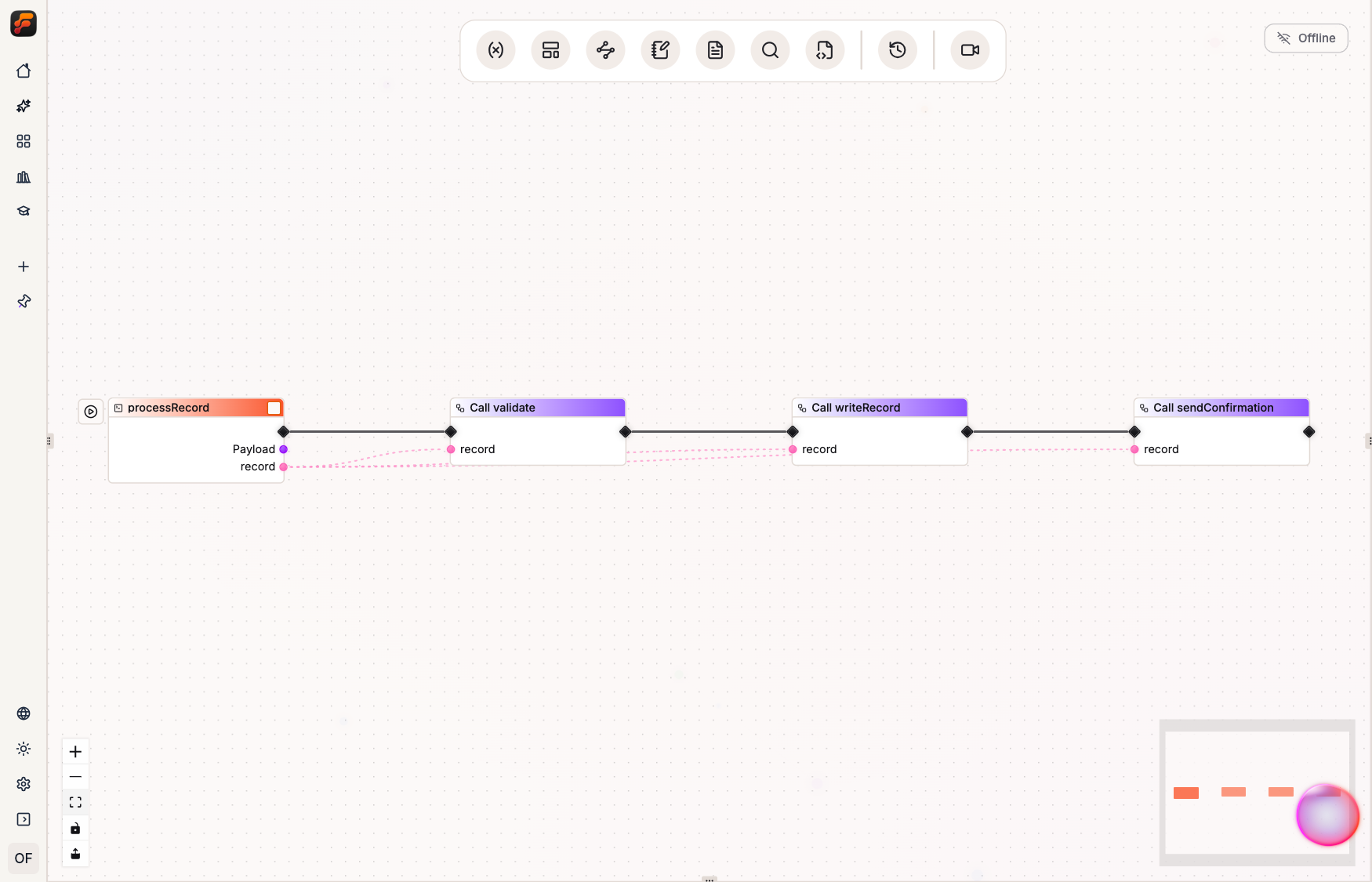
In FlowScript, consecutive impure statements express the same intent. Each operation receives control only after the preceding operation’s selected continuation is reached.
For several ordered branches, use a Sequence control node. Its outputs own the ordering contract.
For concurrent work, use an operation whose contract says parallel. The current Parallel
Execution node exposes repeatable task outputs and a Done continuation. It starts the connected
branches as bounded asynchronous tasks by default, waits for them, and activates Done afterward.
Its optional thread mode uses a multi-thread runtime when available and otherwise logs a warning
and falls back to task mode. Parallel For Each provides the loop equivalent, including a maximum
concurrency input; FlowScript can render its supported form with @parallel.
Task paths do not wire back into Done. Parallel activates that continuation after its branches settle. This example wires one task arm and Done; Studio can add branches through the repeatable output control:
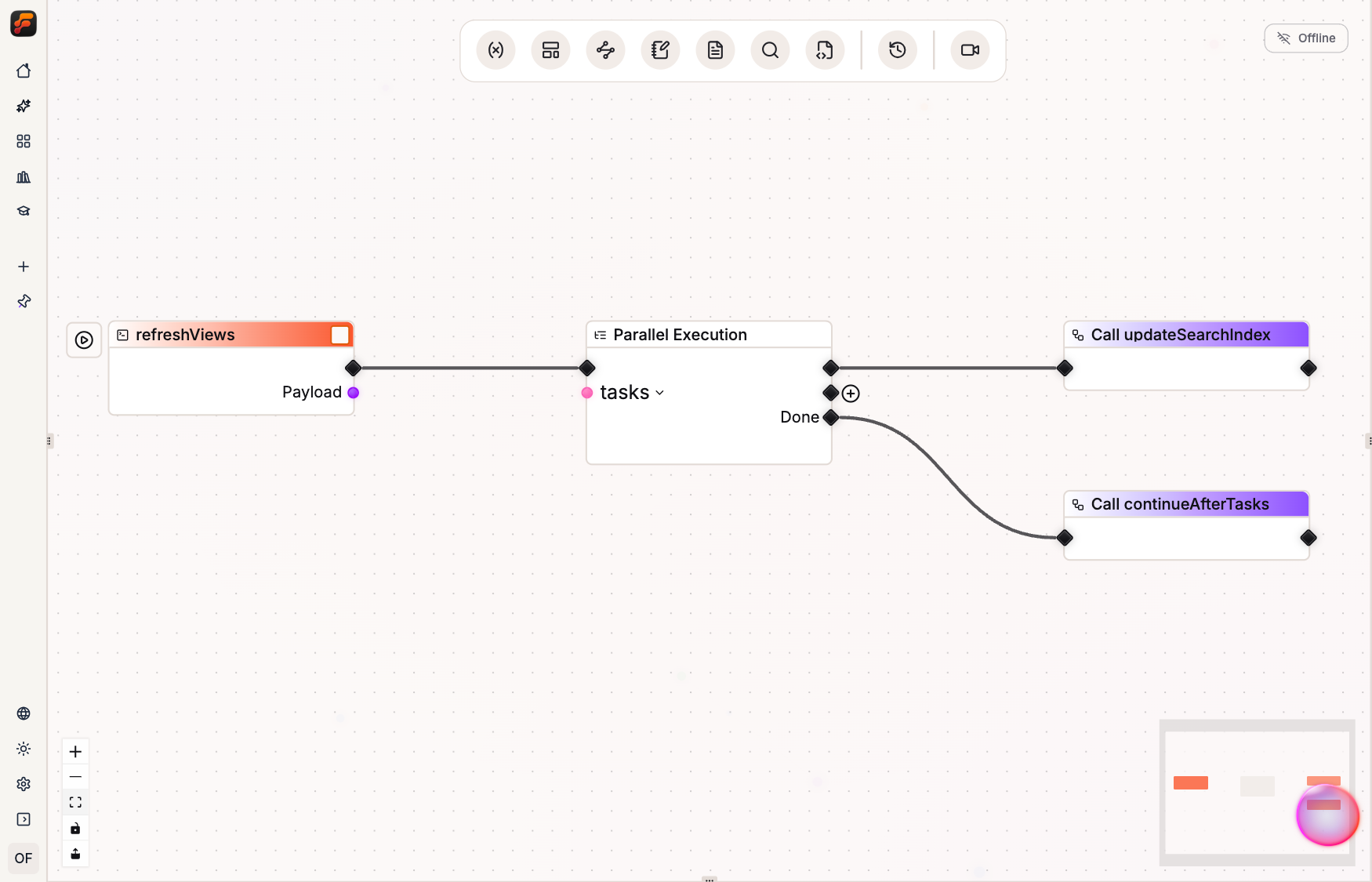
Branches may finish in any order. Avoid races on shared mutable state, and ensure external effects can tolerate that ordering.
Ordinary topology fan-out isolates ready siblings. One failed branch stops its successors while other ready targets continue, bounded by executor capacity. After the siblings settle, an unhandled failure makes the run’s terminal status Failed. A failure that reaches and completes an explicit handler remains visible on its node and in attributed logs without failing the run.
The dedicated Parallel Execution and Sequence nodes currently differ from that general rule. They can record a child error without propagating it to the run’s final status, and Parallel Execution can still proceed to Done after collecting its children. Inspect child logs instead of relying on the outer control node. Test this behavior against the release used by the book.
Sequential paths behave differently, and purpose-built nodes may define their own outcomes. Add an explicit join when all work must finish. Model cancellation or compensation explicitly and verify the selected nodes in the target release.
During an incident, the pins show what was ordered, what ran concurrently, where branches joined, and how failure was routed.
5.6 Layers organize; functions are callable
Section titled “5.6 Layers organize; functions are callable”Large Flows need a way to hide detail without hiding behavior.
A layer folds nodes behind a named, typed boundary. Crossing wires become boundary pins. Opening the layer reveals the same nodes, dependencies, paths, and comments. Collapsing it changes only the view; execution remains the same.
Suppose Incident Triage eventually grows from six nodes to sixty. Normalization might include language detection, identifier extraction, enrichment, and validation. We could collapse that inline region into a layer named Prepare Incident. Before doing so, compare the related function form: FlowScript can directly author the same top-level sentence as named callable boundaries.
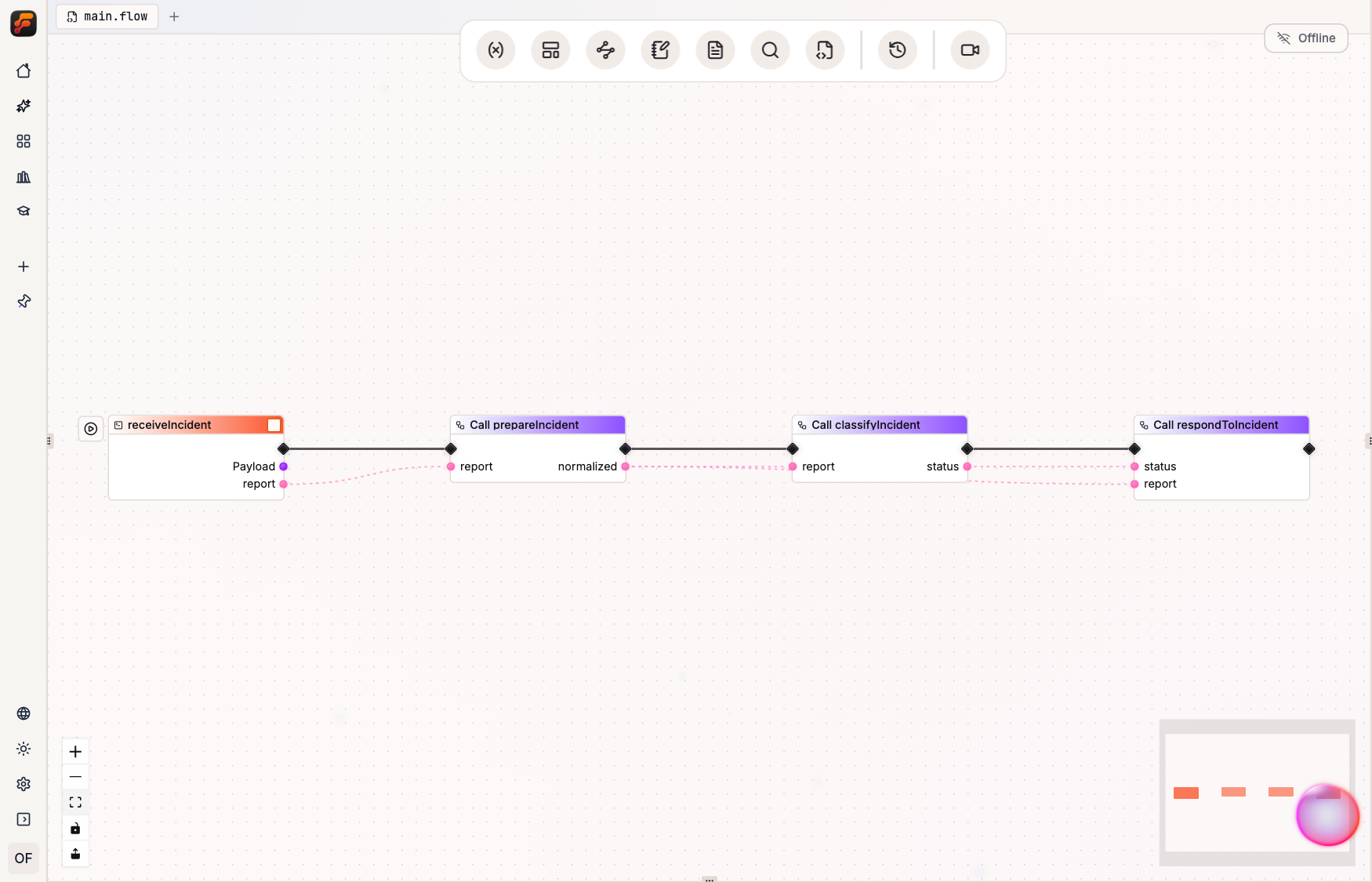
Each purple Call node refers to a function layer. Opening prepareIncident reveals its maintained
implementation and signature. Collapsing the same nodes into an ordinary Prepare Incident
layer would organize one inline region without making it reusable. Start and Return boundaries
show the values and execution paths that cross the edge. Inner failures remain attributed to
their nodes.
A plain layer organizes one inline Board region. A function layer defines reusable logic. Its boundary pins form a signature, and each invocation appears as a Call Function node. FlowScript renders that Flow logic with function syntax.
The distinction produces a simple rule:
- Use a layer when one part of the Flow needs a clearer name and a lower level of detail.
- Use a function when several callers need the same behavior and one maintained contract.
Callable boundaries carry obligations. Pin names must be unique because callers address the signature. An impure function needs a single execution entry and a valid continuation so the runtime knows where the call begins and how the caller resumes. A genuinely pure function instead returns demanded values without pretending to have an execution path.
Name layers and functions after their responsibility, keep boundaries narrow, and review boundary changes like API changes. The next chapter shows how FlowScript records these structures in one document.