8. Calling the Node Library
FlowScript keeps its syntax small and puts most capabilities in the node catalog. Text, HTTP, files, databases, documents, models, and UI arrive as typed operations. Built-in and packaged nodes share one call surface: boxes with pins on the canvas, function or method calls in FlowScript, and named operations at runtime.
Every call resolves to a catalog declaration that the Board and run evidence can identify. This chapter shows how to find a compatible node for a known value and task.
Release check: Qualified calls, all four
useforms, receiver dispatch, name-based output destructuring, generated declarations, editor completion, and context-sensitive search are implemented in the current repository. Ranking by safety, trust, permission, performance, or cost remains product direction. Section 8.5 records a migration gap: the general schema synchronizer can remove stale pins or detach changed-type pins without retaining a node error.
8.1 Qualified calls
Section titled “8.1 Qualified calls”The most reliable way to read a node call is the fully qualified form:
namespace::operation({ pinName: value })The path identifies a catalog namespace and member. The object maps values to input pins:
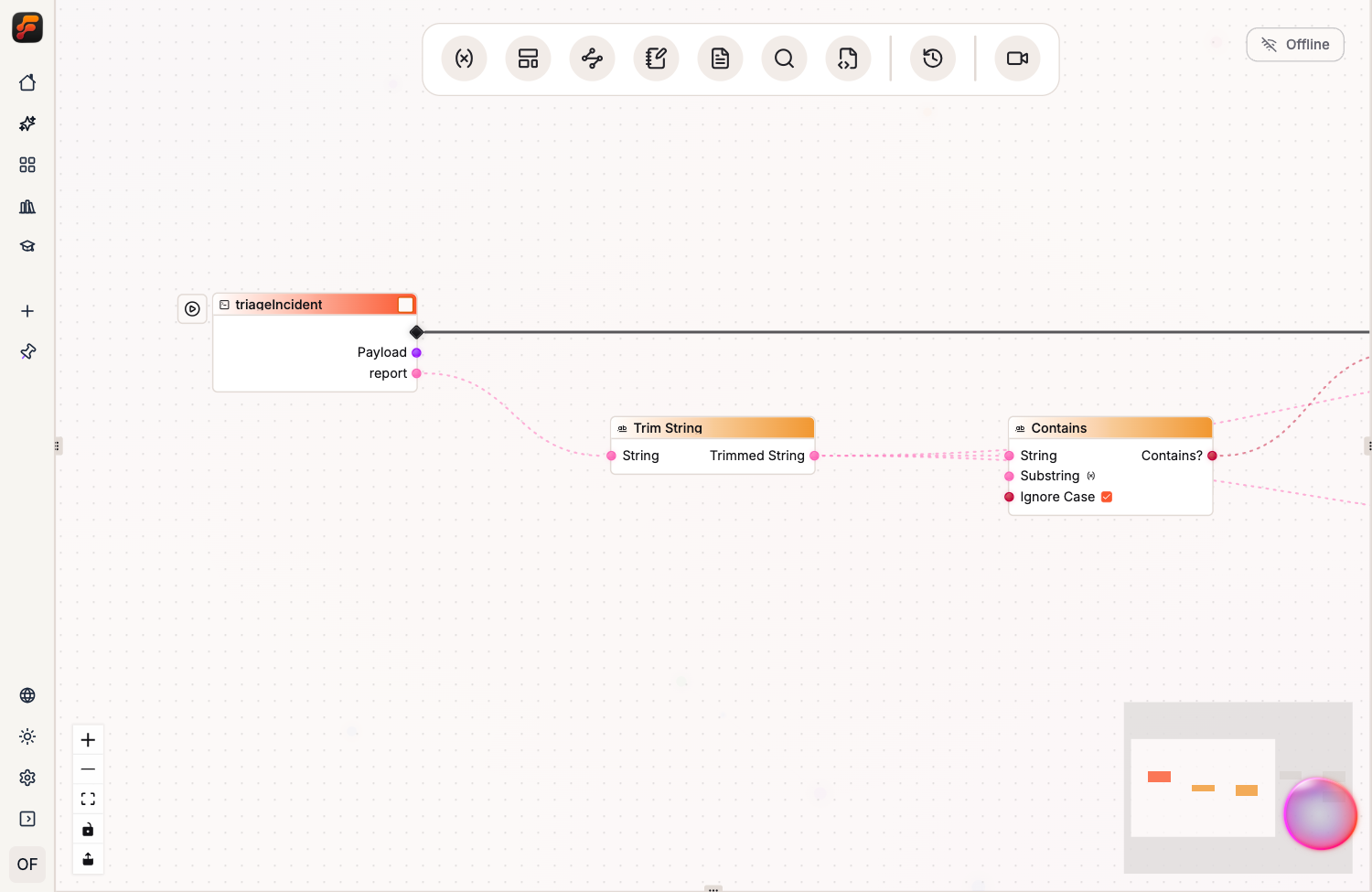
const normalized = string::trim({ string: report })The first string is the namespace, trim aliases the Trim String node, and the object key names
its input pin. normalized receives the sole data output. Reconciliation finds the live catalog
declaration, plans that node, and wires report to it.
Catalog pins often use snake_case internally and render in camelCase, so ignore_case becomes
ignoreCase. Completion inserts the projected name. Apply reports unknown, missing, or duplicated
arguments and calls that match no declaration.
Use named arguments as the default model, even where positional forms are accepted. They expose the pin mapping:
For long signatures, the pin name also explains each value during review.
Generated declarations mark inputs with catalog defaults as optional. Required inputs need a literal, expression, or wire-producing binding. Only declared pins are valid arguments.
:: joins namespace segments, as in ai::ml::read. A dot selects from or invokes on a value. The
reconciler can correct some string.trim(...) mistakes, but source should use :: for namespaces
and . for receivers or outputs.
This Incident example uses several equivalent call forms:
use log::{ info, warn }use string as text
eventsGeneric catalogIncident(payload: Struct, report: string) {    const normalized = text::trim({ string: report })    const { before: system, after: detail, found } = normalized.splitOnce({ separator: ":", fromEnd: false })    if (found) {        info({ message: detail, toast: false })    } else {        warn({ message: normalized, toast: false })    }}
The Flow trims a report such as orders: production is on hold, splits the system name from the
detail, and logs whether the expected structure was found. Trim, Split Once, Branch, and both log
operations remain visible nodes.
A qualified call resolves only against the catalog available to the App and release. It cannot install a package or grant permission. If the package is absent, Apply reports an unknown namespace, member, or declaration.
8.2 Imports and aliases
Section titled “8.2 Imports and aliases”Top-level use declarations shorten repeated namespace paths within one FlowScript document. The
resolved Board nodes stay the same.
FlowScript supports four forms:
use ai::responseuse string::*use string as textuse log::{ info, warn }Each form opens a different scope:
| Form | Meaning | Example call |
|---|---|---|
use ai::response | Bring the final namespace segment into scope | response::make({ ... }) |
use string::* | Make every member of one namespace callable bare | trim({ string: report }) |
use string as text | Give the namespace a local alias | text::trim({ string: report }) |
use log::{ info, warn } | Make only selected members callable bare | warn({ message: report }) |
Our example aliases string as text and imports two logging members. text::trim and
string::trim resolve to the same node type; bare warn(...) resolves through its selected import.
Unknown namespaces, missing members, keyword aliases, and collisions produce diagnostics. An unused valid import produces a non-blocking correction. If two namespaces expose the same member, argument shape may select one; a remaining tie requires a qualified name.
Arrays and strings can both offer contains. Named inputs may resolve a bare call;
string::contains(...) removes any doubt. User functions can also shadow bare catalog members or
method aliases, which produces a diagnostic rather than changing the selected operation silently.
Imports are derived from resolved calls rather than stored as Board entities. Current lowering
uses use ns::* for at least two static calls when no used member collides with a Function,
another node’s flat name, or an already opened member. Method calls do not count; a single call
normally stays qualified.
After Apply, source may render with an equivalent import style. The Board stores node identity,
not an author-written alias such as text, so canonical output may choose string::trim or
use string::*.
For predictable source:
- begin with qualified calls when learning or resolving ambiguity;
- accept autocomplete’s import edit when a repeated namespace becomes noisy;
- let canonical rendering decide whether the final Board still earns that import.
8.3 Method form
Section titled “8.3 Method form”Some catalog nodes designate one data input as a receiver. Their generated declaration contains a
this: parameter. Split Once currently declares its contract in this shape:
function splitOnce( this: string, { string: string, separator: string, fromEnd?: bool }): { before: string, after: string, found: bool };The this: string marker allows the value left of a dot to supply the string input. These calls
resolve to the same node:
const split = string::splitOnce({    string: normalized,    separator: ":",    fromEnd: false,})
const splitAgain = normalized.splitOnce({    separator: ":",    fromEnd: false,})
Method form already binds the receiver pin, so supplying string: normalized again is an error.
One remaining required input may be positional, as in normalized.splitOnce(":"). Use a named
object when several inputs or options remain.
Method syntax adds nothing to a JavaScript prototype. The call still becomes a Split Once node with a String input wire, so duration, failure, permissions, and outputs remain attributable to it.
Receiver contracts power completion. After a string, the editor offers string and universal
operations. Arrays get array operations; a titled Struct can get schema-specific and general
Struct methods. Available packages participate through the active catalog.
An unknown receiver broadens completion. On any, .contains(...) might target a string, array,
or package node. FlowScript uses argument shape and opened namespaces, then requires a qualified
call if candidates remain tied.
Receiver metadata decides whether a node supports method form. A hash operation may declare a text
or byte receiver even though its static name lives under hash; an author may also opt out. Check
the generated declaration.
FlowScript Functions may use their first parameter as a receiver too. The call still targets a visible Function layer. In every method call, the dot binds one declared input pin.
8.4 Single and multiple outputs
Section titled “8.4 Single and multiple outputs”FlowScript handles zero, one, or several data outputs by pin name rather than pin position.
A node with one data output behaves like a value-producing function:
const normalized = text::trim({ string: report })normalized refers to Trim’s only data output. A logger has no data output and renders as a
statement:
warn({ message: normalized, toast: false })For several outputs, select pins by name:
const { before: system, after: detail, found } = normalized.splitOnce({ separator: ":", fromEnd: false,})Before each colon is the output pin; after it is the local binding. before becomes system,
after becomes detail, and found keeps its name. If a release renames a pin, reconciliation
reports the missing output instead of binding by position.
The alternative is to retain a name for the call and select outputs as fields:
const split = normalized.splitOnce({ separator: ":", fromEnd: false })if (split.found) { warn({ message: split.after, toast: false })}Here .found and .after select Split Once output pins. Resolution checks declared node outputs
before treating the expression as a Struct field read. Chapter 9 follows that distinction.
With several outputs, FlowScript looks for a conventional default named result, value,
output, out, or batch. For a method-form transformation, it can instead select the output
that matches the receiver stem, such as map_in to map_out or array_in to array_out. Other
pins remain selectable. Split Once has no default among before, after, and found, so
consumers must name an output.
Array destructuring is intentionally unsupported:
// Rejected: output meaning must not depend on pin position.const [system, detail, found] = normalized.splitOnce(":")Pin order is presentation metadata; pin names are the contract. Object destructuring survives reordering and maps visibly to data wires.
When one output has several consumers, every use resolves to the same output pin and the Board records the fan-out. The local name introduces no hidden state.
8.5 Generated .flow.d declarations
Section titled “8.5 Generated .flow.d declarations”Flow-Like generates .flow.d files from node metadata so editor assistance matches the catalog
used for reconciliation and execution.
An abbreviated declaration for Contains looks like this:
declare namespace string { /** * @node string_contains @receiver string @alias stringContains * @param string * @param substring * @param ignoreCase (optional) * @returns contains */ function contains( this: string, { string: string, substring: string, ignoreCase?: bool } ): bool;}The declaration records:
- the namespace and member provide the qualified spelling;
- the object lists the static call’s complete data-input shape;
?records an optional input;this:and@receiveridentify method binding;- the return type describes one output or an object of named outputs;
@nodepreserves the internal catalog identity;@aliaspreserves the legacy flat camelCase spelling; and@impure, when present, records that the node has Execution pins.
Node, pin, and output descriptions become hover documentation. Struct schemas live in a sidecar so
tools can resolve fields without expanding JSON Schema in every signature. names.json maps node
types, qualified names, aliases, receivers, receiver classes, and categories.
Files are grouped by top-level domain and source package. Studio’s FlowScript editor uses the active catalog for completion, hover, signatures, and diagnostics. The VS Code extension reads the declarations, and FlowPilot queries the same index before writing source. All use the same pin names.
A declaration snapshot must match the App’s catalog. Packages can add names or collisions, and
upgrades can change pins. The parser does not bind calls from .flow.d; reconciliation uses the
live catalog. Book examples therefore need catalog-aware reconciliation as well as parsing.
Nodes carry a schema version for migration. When the catalog is newer, synchronization matches pins by name, preserves IDs and wires for compatible types and shapes, adds pins, refreshes catalog metadata, and lets dynamic nodes rebuild derived pins. Widening a data pin to Generic preserves a compatible wire.
The intended rule is to migrate proven-safe changes and leave unsafe ones visible for repair. The node remains on the Board today, but the general synchronizer applies that rule unevenly. On an ordinary node it removes a pin absent from the new catalog. A type or collection-shape change clears connections and resets the default, then clears the node error. Some schema-driven nodes already retain wired stale pins and report an error, but this is not yet universal.
If a package or node type disappears, Studio keeps the node on the Board and marks it with an unavailable-package warning. This preserves its location and identity, but does not cover a pin-level breaking change in an installed package.
Until migration applies the intended rule everywhere, inspect package updates and affected Boards before treating an upgrade as automatic. Unsafe changes should stay visible for repair and must never alter a program silently.
8.6 A large library without a memory test
Section titled “8.6 A large library without a memory test”Catalog search should work even when the function name is unknown.
The checked-in declarations contain 1,668 node entries at revision 839395640; packages and
releases change that count. Type and intent metadata make the library searchable in context.
In Studio, opening Actions on empty canvas space supports browsing and text search across node names, friendly names, categories, descriptions, and pin names. Search supports prefixes and limited fuzzy matching. Without a query, results are primarily alphabetical.
Dragging a wire into empty space enables Context Sensitive mode by default. It keeps nodes with an opposite-direction pin compatible with the carried value, then search narrows the set. Choosing a result connects the matching pin.
The filter considers direction, data type, collection shape, Generic specialization, schema enforcement, and schema-adopting Struct boundaries. Board validation still checks the connection. Turn Context Sensitive off to explore the full catalog.
FlowScript uses the same context at the cursor. After normalized. it offers String receiver
nodes; after string:: it lists namespace members. A bare call can offer an unopened member and
insert the needed use line. Hover shows signatures, argument completion shows remaining pins,
and constrained pins can offer allowed values. FlowPilot queries the same declarations by intent
and returns exact live call forms.
Current visual search ranks textual relevance across names, categories, pins, and descriptions. It does not rank compatible nodes by package trust, permission breadth, quality, performance, or cost.
The planned direction is policy-aware ranking after compatibility. When several nodes fit, Flow-Like could prefer one that matches the organization’s trust, permissions, performance, and cost policy, while explaining the ranking and keeping alternatives visible. Weighting, overrides, and provenance remain governance work.
Discovery follows the same loop on the canvas and in FlowScript:
Start with a typed value or required pin → filter to compatible operations → search by the task you mean → inspect the declaration and tradeoffs → place or call the node → let reconciliation verify the exact contractWhen no node expresses the intent, compose lower-level nodes or add a reviewed package with a typed, capability-scoped contract. Later chapters show how WASM extensions enter an App and join the same catalog.
The next chapter shows how operators, templates, ternaries, and field access lower to catalog operations and visible wiring.