10. Branches, Loops, Parallelism, and Return
FlowScript maps familiar control syntax to visible execution paths:
if (critical) {    notifyOperations()} else {    recordForReview()}
for (const report of reports) {    classify(report)}
An if is a node with execution outputs. A collection loop owns an iterable, exposes value and
index, and triggers its body path for each item. While owns a condition and iteration limit. The
statement after either loop connects to Done. A return wires data to a function boundary or
terminates one Event branch.
The canvas therefore carries runtime meaning. Node position has no effect on execution. A changed wire can change which work runs and what follows it.
Every path that can run, fail, repeat, or finish must remain visible in source and on the Board.
During the Chapter 1 incident, the visible Flow shows the decision, attempted call, expected Error route, unexpected failures, and recovery work at the responsible nodes.
Release check:
@parallelcurrently sets a concurrency limit of 30, and plainwhilepermits at most 15 iterations. FlowScript has nobreakorcontinue; functionreturndoes not yet terminate the whole function. Loop control nodes can log and absorb child-path errors, so work may continue and a run may end with Success despite Error evidence. This remains an implementation gap. The sections below mark the behavior of each loop.
10.1 if, else if, and else
Section titled “10.1 if, else if, and else”Use if when a Boolean value chooses an execution path:
if (report.contains({ substring: "production is on hold", ignoreCase: true,})) { error({ message: report, toast: false })} else { info({ message: report, toast: false })}The Boolean condition feeds a branch node. Its blocks connect to True and False execution outputs, and only one activates. Position on the canvas cannot change the choice; wires and data do. The condition itself is data flow into the branch, so failures while producing it remain attributable to their source nodes.
Chapter 9’s ternary makes a different kind of choice:
let status = critical ? "critical" : "investigate"A ternary selects a value. if selects a path, which suits calls, writes, retries, tickets, and
other work that should run on only one side.
FlowScript accepts an else if ladder:
if (productionStopped) { status = "critical"} else if (degraded) { status = "warning"} else { status = "healthy"}Canonical source currently renders the same graph as a nested branch:
if (productionStopped) { status = "critical"} else { if (degraded) { status = "warning" } else { status = "healthy" }}The nested form matches the topology: the second decision is reachable only through the first branch’s False arm. Its indentation shows that ownership.
A branch is not an error handler
Section titled “A branch is not an error handler”A False arm means the condition evaluated to false; it catches no error from the condition or True arm. Expected negative outcomes need a modeled execution output. Recoverable unexpected node failures use Handle Errors. The Board shows these contracts separately.
10.2 Named execution arms
Section titled “10.2 Named execution arms”Some decisions need labels beyond True and False. The HTTP API Call node exposes Success and Error, which FlowScript preserves in a named arm block:
const request = http::request({ method: "GET", url: healthUrl })const apiCall = http::fetch({ request: request })apiCall { execSuccess: { info({ message: "Dependency is reachable", toast: false }) } execError: { createIncidentTicket() }}apiCall is a handle that can expose data such as apiCall.response. The block connects work to
its execution pins. Nodes with more outcomes use one named block per connected arm.
For the current HTTP node, a completed 2xx response selects Success and a completed non-2xx
response selects Error. Transport failure, an invalid request, or a response-read failure can
raise an unexpected node error. Handle Errors adds an On Error path and Error string output
for that category.
The Board keeps both routes visible:
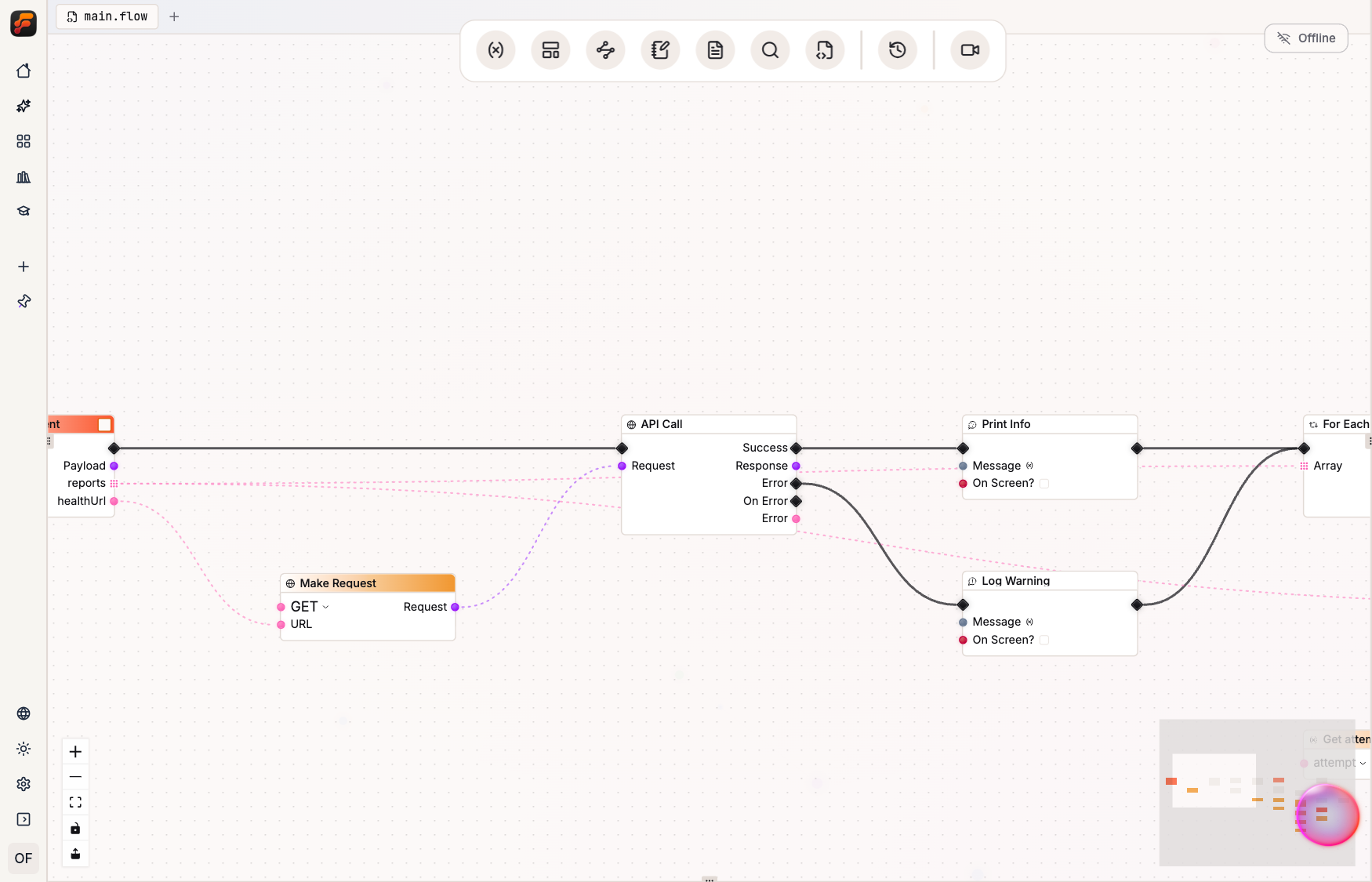
A Flow can route Error to a retry, ticket, or domain response. If an On Error recovery path completes, execution can continue while the original node retains failed evidence.
This separation matters in operations: an HTTP 503 is an expected protocol outcome, while a malformed request value indicates that the node could not perform the call as modeled. They need different recovery policies and traces.
Arm names belong to the node contract. Canonical source camel-cases internal pin names, such as
exec_error to execError; Apply also recognizes supported raw and friendly spellings. Use Board
rendering, editor completion, or Apply’s available-output diagnostic for the accepted name.
Some two-output nodes render as if (nodeCall()) with comments such as // exec_out_exists and
// exec_out_missing after the braces. These semantic labels preserve the graph output represented
by each arm.
10.3 Sequential for … of
Section titled “10.3 Sequential for … of”The ordinary collection loop is sequential:
for (const report of reports) { classify(report)}Bind the zero-based index as well when identity or ordering matters:
for (const [index, report] of reports) { info({ message: `#${index}: ${report}`, toast: false })}The loop evaluates its array once and processes values in order. It publishes each value and index, then waits for the body chain to settle before starting the next item. Done activates after all items and starts the following statement.
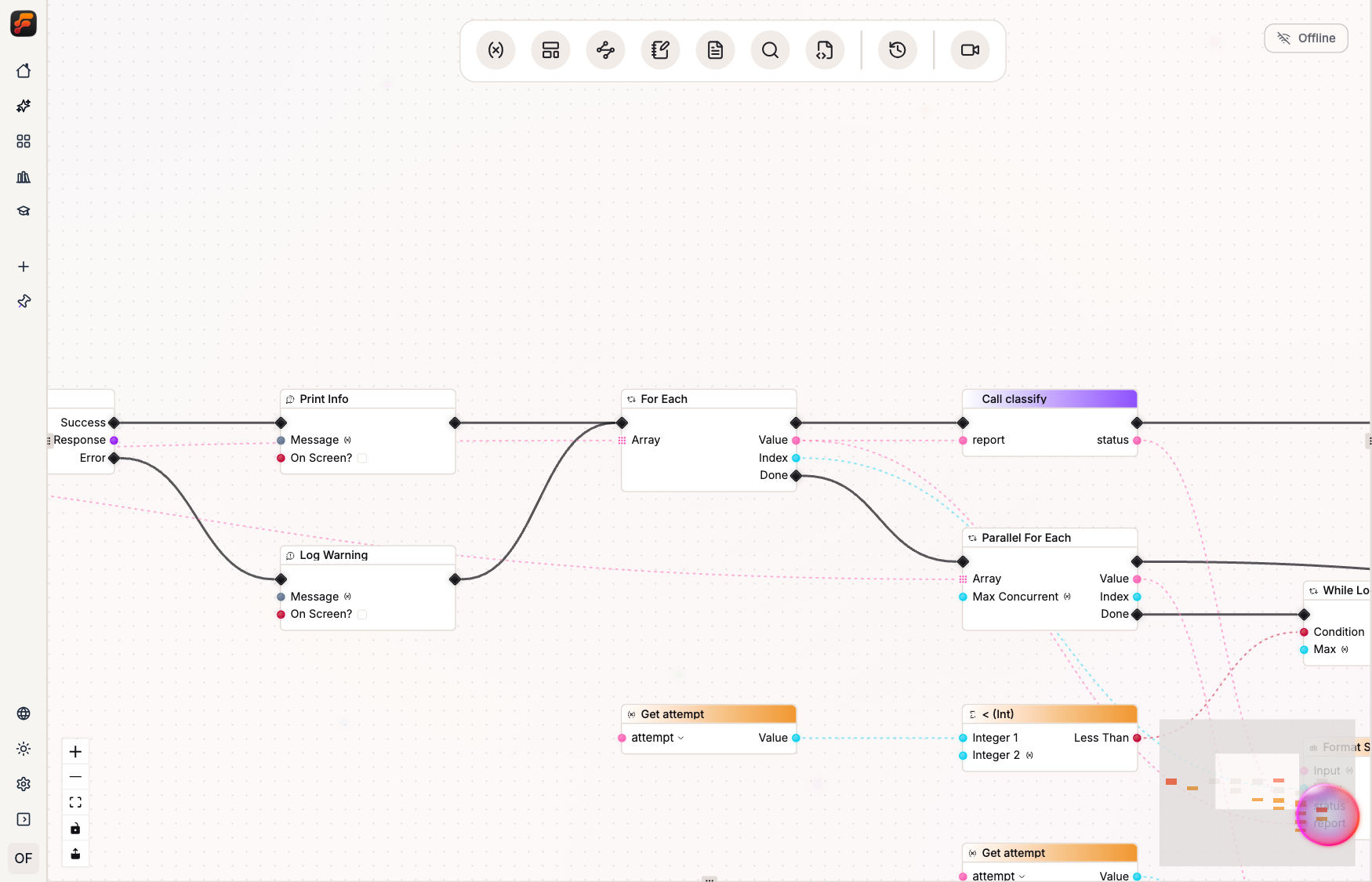
Use ordinary for when iterations touch shared or external state: rate-limited APIs, ordered or
deduplicated tickets, dependent database writes, bounded model spend, or any operation whose
idempotency remains unproven.
Sequential here describes scheduling, not outcome policy. The loop still owns every iteration and decides how execution continues after a child path settles.
Sequential loops are not fail-fast today. When a body chain returns an unhandled error, that chain stops. The loop logs an Error under its own node and names the iteration, then continues. Logs from the failed chain retain child-node attribution. A modeled or handled failure can create a ticket before later items run, which suits batches where one bad record should not discard the rest.
The loop node returns success after logging a child error, so the run may report Success despite a failed child trace. The intended invariant marks the aggregate run Failed after remaining work settles. Until it is uniform, a Flow that must report “all records succeeded” should collect per-item outcomes and make the final decision visible.
10.4 @parallel for
Section titled “10.4 @parallel for”Parallelism is an opt-in promise that iterations may overlap:
@parallelfor (const report of reports) { inspectIndependentReport(report)}Parallel For Each starts independent items up to its configured concurrency limit. @parallel
is lossless only at the default of 30; a custom limit remains explicit:
for (const parallelForEach of control::parallelForEach({ array: reports, maxConcurrent: 5,})) { inspectIndependentReport(parallelForEach.value)}maxConcurrent: 1 schedules one task at a time. A positive value bounds active item/body-root
tasks; with one body root, it matches active iterations. 0 means unlimited, and current code
treats every non-positive value that way. Avoid unlimited concurrency for external services.
Done is a barrier, not an ordering guarantee
Section titled “Done is a barrier, not an ordering guarantee”Parallel For Each activates Done after every child settles. It exposes no collected-results array, and effects may finish in any order. When order matters, carry the original index, collect results, and sort them. Gather provides an execution barrier without collecting data values. Node position, log arrival, and apparent finish order reveal nothing about result order.
A failing child does not cancel siblings. The node schedules remaining items, drains child work, logs each failure, activates Done, and returns success. The sequential loop’s aggregate-status gap also applies.
Before opting in, verify that order is irrelevant, writes are idempotent, retries cannot duplicate effects, downstream rate and connection limits are known, concurrent model/network/memory cost is bounded, failures are collected, and sibling behavior after failure is acceptable. Keep external calls, ticket creation, and database writes sequential until that contract justifies overlap.
Already-running siblings are especially important: the current node does not cancel them after a failure. Any side effects they start must remain safe even when another item has already failed.
10.5 Bounded while
Section titled “10.5 Bounded while”Flow loops must have an operational ceiling. The compact form is:
let attempt = 0while (attempt < 3) { pollDependency() attempt = attempt + 1}Before each body run, While retriggers its condition dependencies and evaluates the Boolean. The
current node also has a maxIter guard. Plain while (condition) keeps the default of 15; a custom
guard makes the node call explicit. The body starts only when the refreshed condition is true:
while (control::whileLoop({ condition: retryReady, maxIter: 3 })) { pollDependency()}The maximum bounds body starts. It cannot prove progress, enforce a wall-clock deadline, add delay or backoff, or cancel a slow body operation. Model those policies in the Flow and called nodes.
If the condition remains true at the maximum, While silently activates Done. It has no Exhausted output and emits no warning for reaching the ceiling. When exhaustion means failure, maintain an attempt value and check it after the loop before choosing Success, Retry Later, or Escalate.
Body failures are logged; the loop reevaluates its condition and may finish successfully. Direct condition evaluation failures can propagate. Failure to retrigger a dependency is currently logged before the loop exits through Done. Test these release-sensitive details before relying on them.
Cancellation is observed at node boundaries. Long-running nodes must cooperate with it themselves. Plain loop nodes observe cancellation less consistently while walking or scheduling iterations than batch-loop variants. Keep an iteration maximum and external-operation timeouts even when callers can cancel.
10.6 Stopping and skipping are structural today
Section titled “10.6 Stopping and skipping are structural today”FlowScript does not currently have break or continue statements. To skip the remainder of one
ordinary iteration, put that remainder behind a branch:
for (const report of reports) { const relevant = isRelevant(report) if (relevant) { classify(report) persistFinding(report) }}The empty False arm reaches the body end and advances the loop. The Board shows the skipped path.
The catalog’s For Each (Break) node samples a Boolean Break input before the loop and after each
body root. True stops remaining roots and items, then activates Completed. This visual node is
outside FlowScript’s structured loop registry, so it does not round-trip as break or ordinary
for sugar. Use it explicitly and verify rendered source against the target release.
This authoring gap needs a future text form that preserves the stop condition and Completed path.
10.7 return is a boundary, not stack unwinding
Section titled “10.7 return is a boundary, not stack unwinding”In a function, return values map positionally to the declared output pins:
function classify(report: string): (status: string, normalized: string) { const normalized = report.trim() let status = "investigate" if (normalized.contains({ substring: "production is on hold", ignoreCase: true })) { status = "critical" } return status, normalized}The expressions wire positionally to status and normalized. Literals can become typed values,
and a bound call output can supply a return pin. Validation reports extra return values or output
pins without sources instead of guessing at an arity mismatch.
What this does not mean today is JavaScript-style early return:
// Do not rely on this shape to terminate the whole function today.if (invalid) { return "rejected"}performSideEffect()Current function reconciliation wires data to layer output pins and has no function-wide Return node. FlowPilot’s intermediate representation rejects nested function returns and permits one final, unconditional top-level return. For early selection, branch to compute the result, rejoin, and return once at the boundary. This makes every declared output’s source visible before the function completes.
An Event return has a different implementation:
eventsGeneric status(payload: Struct) { return "accepted"}This becomes a terminal Return Result node with no execution successor. It ends that branch and publishes one Event result. Events accept one return value; use a Struct for a compound response.
An Event return does not cancel sibling branches. Execution surfaces also aggregate competing results differently. Synchronous server and remote callers usually keep the first; subcontext merging overwrites with the last merged child; UI run state shows the last received result; SSE forwards every result. Parallel timing makes implicit selection unreliable.
These differences are observable API behavior. A Flow with several result paths may answer differently depending on how it was invoked, even when its Board is unchanged.
Produce one logical result path per invocation. Never let racing return statements choose an
answer by timing.
When branches produce different outcomes, join their data and select once before the result boundary. This also eases migration to a future function-wide Return node.
10.8 Read the whole control-flow example
Section titled “10.8 Read the whole control-flow example”The Chapter 10 fixture combines the forms in one small incident coordinator:
use log::{ info, warn }
function classify(report: string): (status: string) {    let status = "investigate"    if (report.contains({ substring: "production is on hold", ignoreCase: true })) {        status = "critical"    }    return status}
eventsGeneric coordinateIncident(payload: Struct, reports: string[], healthUrl: string) {    const request = http::request({ method: "GET", url: healthUrl })    const apiCall = http::fetch({ request: request })    apiCall {        execSuccess: {            info({ message: "Dependency is reachable", toast: false })        }        execError: {            warn({ message: "Dependency returned an unsuccessful response", toast: false })        }    }    for (const [index, report] of reports) {        const status = classify(report)        info({ message: `#${index} ${status}: ${report}`, toast: false })    }    return "incident coordination completed"}
On the Board, the Event opens a path and API Call splits it into named outcomes. Because both arms continue, the following statement fans in from both tails; HTTP has no separate Done output. For Each owns the reports, exposes value and index, and joins at Done. The function exposes one output pin. Return Result ends the Event branch and supplies the caller’s value.
The canonical fixture also includes @parallel for and bounded while; the repository’s
FlowScript parser/renderer test checks it. It stays small enough to inspect in both views. Move
larger logic into visible layers and functions.
FlowScript uses familiar control syntax only where it maps faithfully onto the Board.